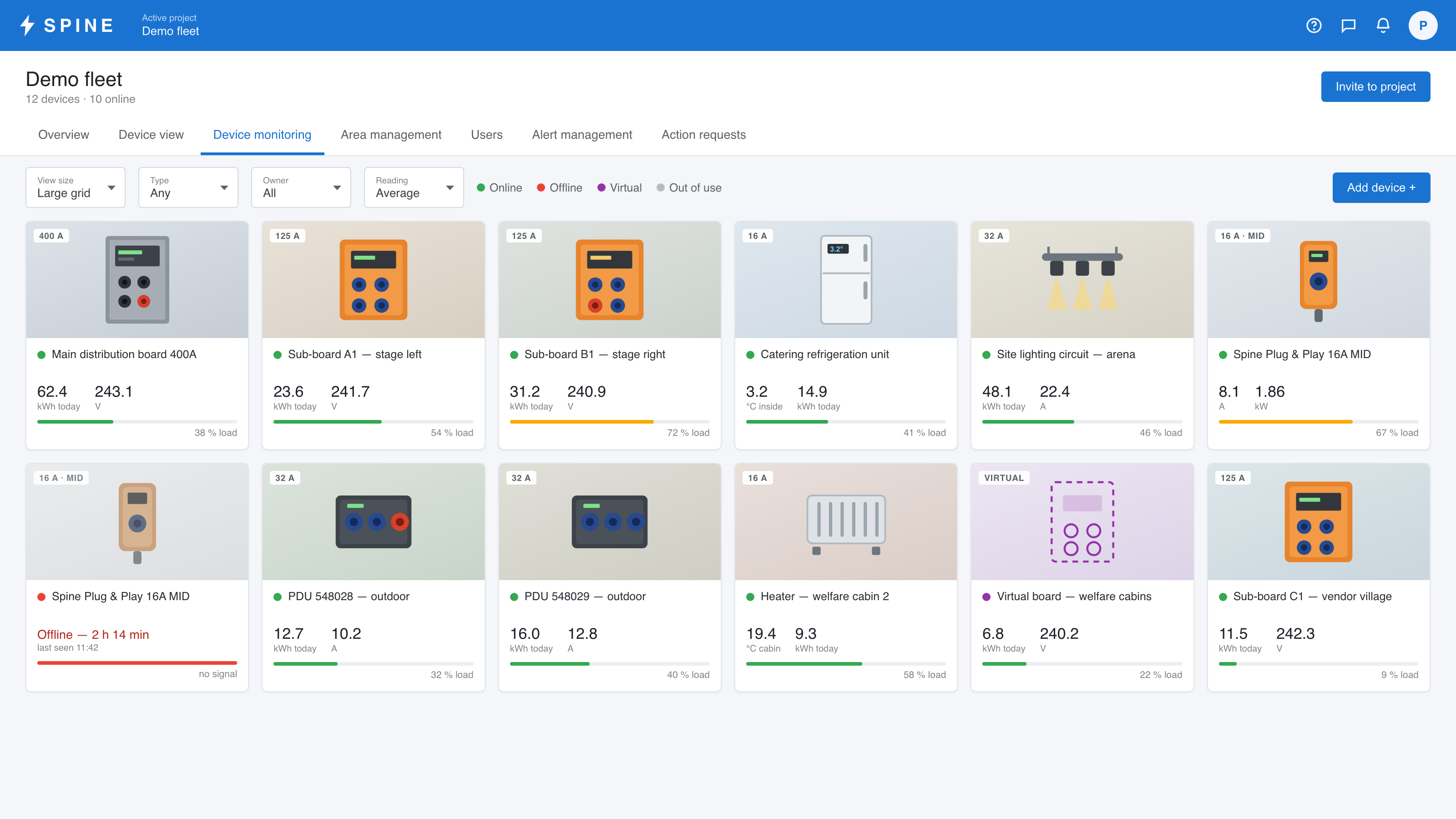
Documented evidence on every asset.
Per-asset record of load, runtime and fault flags between dispatch and return. When the manufacturer challenges a claim, the depot answers with timestamped data — not depot-foreman recall.
Live power, load and runtime per asset. Charge customers for the monitoring, cut warranty losses, and control every board from one screen. In live production across the Nordic rental market.
Spine is already in use across the Nordic rental market, Cramo and Renta among the groups running it. Live in six countries today.
Leading hire firms resell monitoring data through their customer portals as a paid line, comparable to the premium already charged for tracked tower lights or monitored generators.
Two outcomes for the hire firm: additional per-rental revenue, and stronger customer retention as the site team becomes dependent on the dashboard.
On the depot side: documented evidence for warranty disputes, accurate pricing on heavy-utilisation customers, and automatic low-load protection on generator jobs.
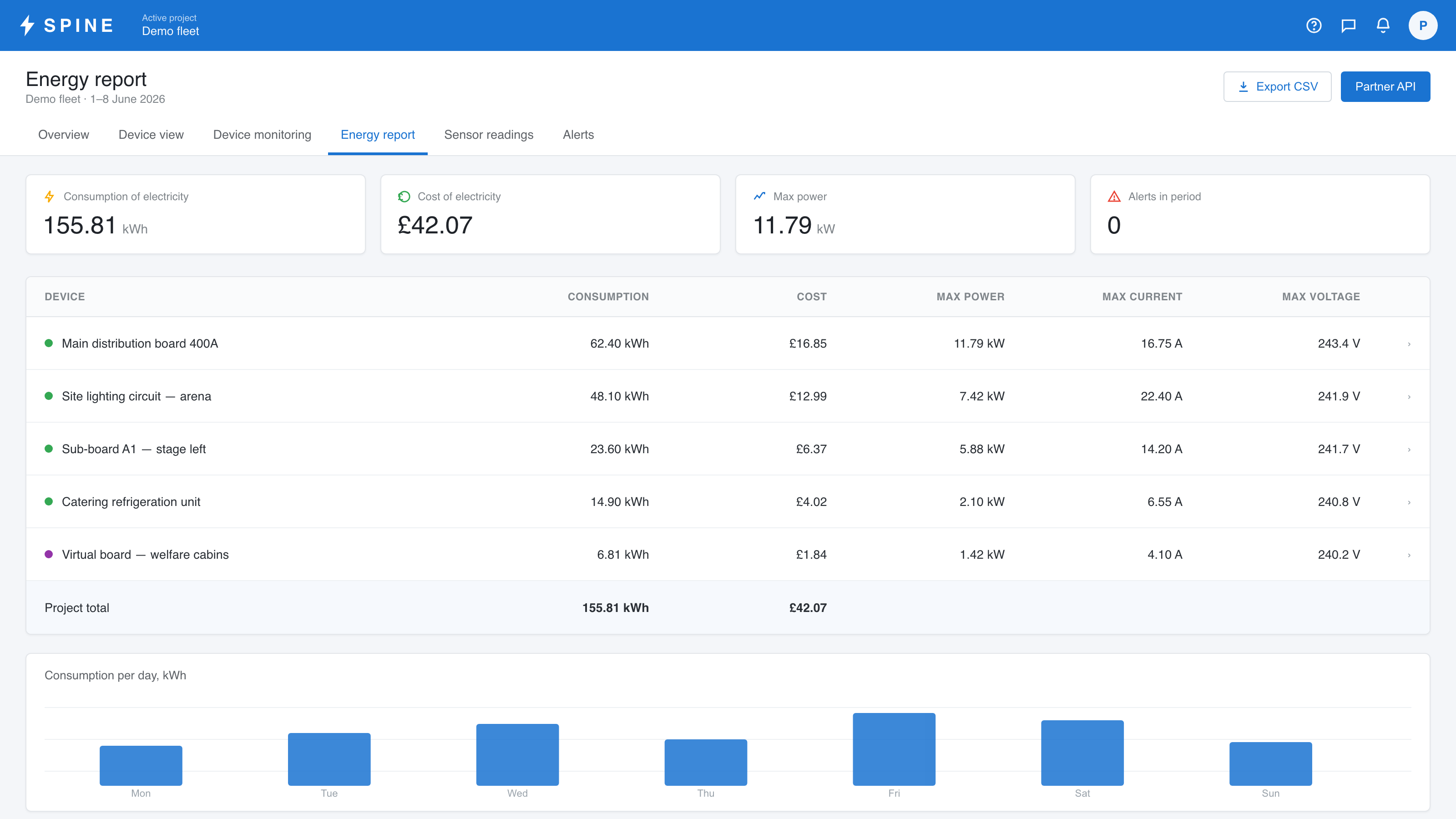
Per-rental kWh, runtime, voltage history. Surfaced through your portal via the Partner API, or via the Spine front-end white-labelled.
Per-asset record of what each unit did between dispatch and return. Loss-adjuster evidence, not depot-foreman recall.
Visible 18-hour duty-cycle vs 6-hour. Pricing leverage on the next renewal.
When generator load drops too low, Spine switches auxiliary load on automatically, and off again as demand rises. Generators stay in working condition longer.

Spine runs on the same device whether it sits on a construction-site board or a hire-fleet distribution board, on mains or generator power. Genset load management is Power and Control combined; humidity inside a welfare unit is Climate; per-customer dashboards run on Connections.
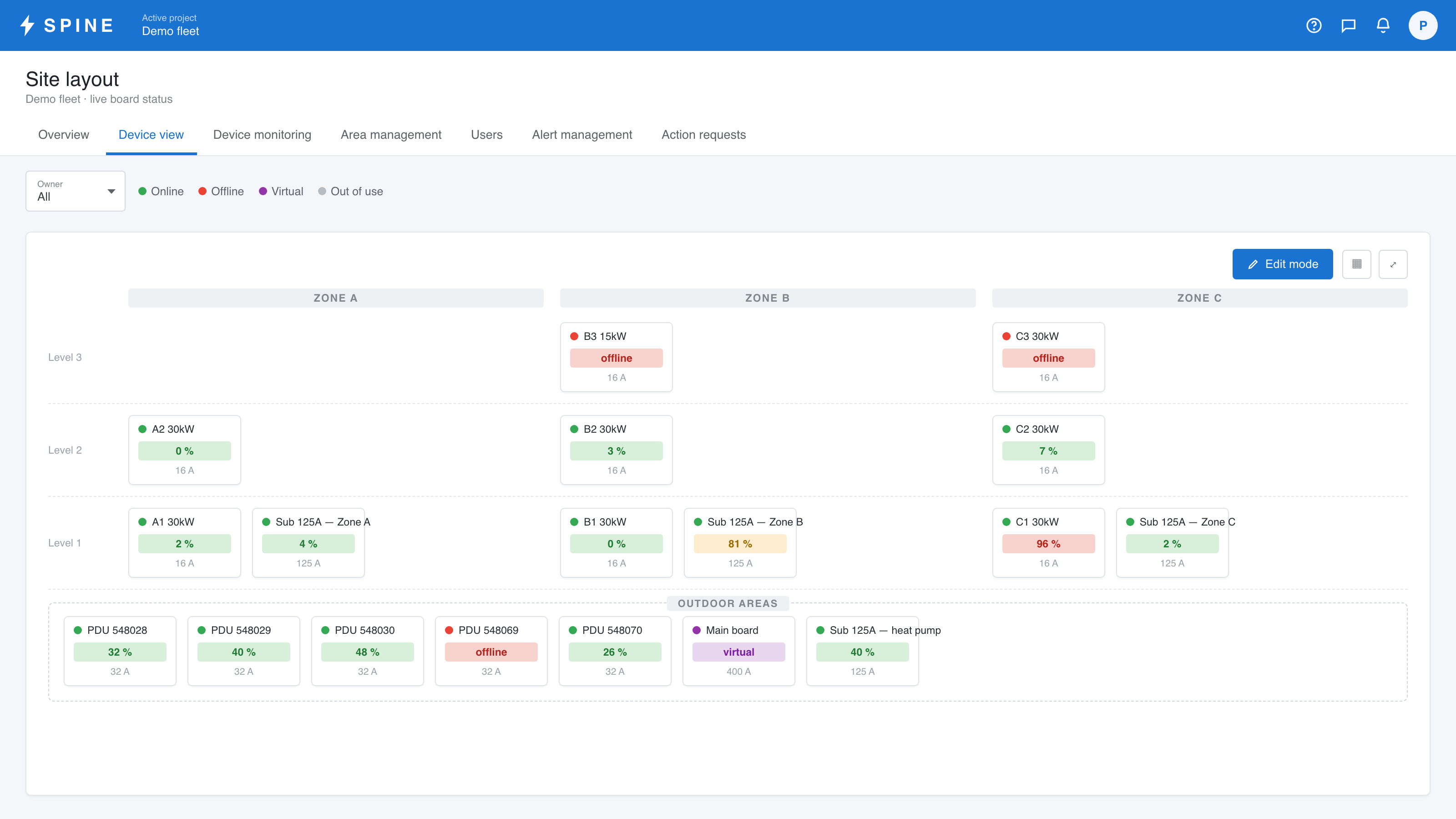
Three views from the Spine portal. The platform is running across a Nordic hire fleet today.
Three deployment scenarios drawn from live production.
Per-asset record of load, runtime and fault flags between dispatch and return. When the manufacturer challenges a claim, the depot answers with timestamped data — not depot-foreman recall.
A live view your customer accesses through your portal — kWh consumed, runtime and load, per-rental summary. A paid line on the contract; a reason for the customer to renew next quarter.
Automatic auxiliary load on/off keeps generators correctly loaded when site demand drops too low, so they stay in working condition longer. Temperature alarms catch loose connections before they become electrical-cabinet fires.

Spine monitors the 3-phase distribution boards across your fleet. It runs on mixed fleets, regardless of equipment vendor.
Spine is in production across the Nordic rental market, Cramo and Renta among the groups running it. Further references are available on request.
Spine reads the 3-phase distribution boards across the fleet — generators, transformers, distribution panels and MID-grade kWh meters. It gives the depot and the customer one live view of load, runtime and consumption per board.
Yes, via the Partner API. Existing integrations include event triggers (asset on/off-hire, fault flags, end-of-rental energy report) that push into inspHire-, MCS- or Syrinx-based systems. Integration specifics are scoped in your offer; if your stack is bespoke, a one-week scoping engagement covers it.
Plug & Play unit on a standard 3-phase distribution board: under 15 minutes per asset, no electrical certification needed beyond the board's existing first-fix. 4G auto-connects to the strongest local network on power-up. Data starts flowing within five minutes of connection. Integrated-into-board variant: configured at the TSR-Elsite factory; arrives pre-commissioned.
Direct line to the TSR-Elsite Spine engineering team during European business hours. Out-of-hours emergency contact for production-blocking faults — same engineer who deployed your fleet, not a Tier-1 BDR. Contract scope is per-deployment; specifics in your offer.
Per-device + license, charged per-asset or per-fleet depending on volume. Indicative pricing is in the offer we send you, with typical per-asset cost per month included. Full quote is prepared after the project conversation.
Tell us a bit about your fleet and we send an indicative offer with per-asset pricing, deployment timeline and integration paths within one business day.
No call needed to see the numbers. If it looks right, we book a short call to finalise.